Note to Readers

Please Note: The editor of White Refugee blog is a member of the Ecology of Peace culture.

Summary of Ecology of Peace Radical Honoursty Factual Reality Problem Solving: Poverty, slavery, unemployment, food shortages, food inflation, cost of living increases, urban sprawl, traffic jams, toxic waste, pollution, peak oil, peak water, peak food, peak population, species extinction, loss of biodiversity, peak resources, racial, religious, class, gender resource war conflict, militarized police, psycho-social and cultural conformity pressures on free speech, etc; inter-cultural conflict; legal, political and corporate corruption, etc; are some of the socio-cultural and psycho-political consequences of overpopulation & consumption collision with declining resources.

Ecology of Peace RH factual reality: 1. Earth is not flat; 2. Resources are finite; 3. When humans breed or consume above ecological carrying capacity limits, it results in resource conflict; 4. If individuals, families, tribes, races, religions, and/or nations want to reduce class, racial and/or religious local, national and international resource war conflict; they should cooperate & sign their responsible freedom oaths; to implement Ecology of Peace Scientific and Cultural Law as international law; to require all citizens of all races, religions and nations to breed and consume below ecological carrying capacity limits.

EoP v WiP NWO negotiations are updated at EoP MILED Clerk.
Showing posts with label A4A: Self-Deception * Hatred. Show all posts

Monday, July 26, 2010

Morality and Abstract Thinking: How Africans may differ from Westerners


Morality and Abstract Thinking

How Africans may differ from Westerners

by Gedaliah Braun
American Renaissance


A public service billboard in South Africa. Note old tire and gas can.

I am an American who taught philosophy in several African universities from 1976 to 1988, and have lived since that time in South Africa. When I first came to Africa, I knew virtually nothing about the continent or its people, but I began learning quickly. I noticed, for example, that Africans rarely kept promises and saw no need to apologize when they broke them. It was as if they were unaware they had done anything that called for an apology.

It took many years for me to understand why Africans behaved this way but I think I can now explain this and other behavior that characterizes Africa. I believe that morality requires abstract thinking—as does planning for the future—and that a relative deficiency in abstract thinking may explain many things that are typically African.

What follow are not scientific findings. There could be alternative explanations for what I have observed, but my conclusions are drawn from more than 30 years of living among Africans.

My first inklings about what may be a deficiency in abstract thinking came from what I began to learn about African languages. In a conversation with students in Nigeria I asked how you would say that a coconut is about halfway up the tree in their local language. “You can’t say that,” they explained. “All you can say is that it is ‘up’.” “How about right at the top?” “Nope; just ‘up’.” In other words, there appeared to be no way to express gradations.

Racism, Guilt, Self-Hatred and Self-Deceit: A Philosophers Hard-Headed Look at the Dark Continent..


Light on the Dark Continent

Fascinating observations of an American who has lived in Africa for nearly 30 years.

Reviewed by Jared Taylor
American Renaissance


Racism, Guilt, Self-Hatred and Self-Deceit: A Philosophers Hard-Headed Look at the Dark Continent, by Gedahlia Braun [AmRen]

“Almost no one, black or white, left or right, ever says anything but rubbish about race.” So writes Gedahlia Braun in a remarkable book that is anything but rubbish. Racism, Guilt and Self-Deceit is one of those rare books so full of insight and good sense that they are a pleasure to write about. Since the subject is race, this book has not found a commercial publisher, but it can be ordered directly from the author.

Dr. Braun has lived in Africa with only brief interruptions since 1976 and in South Africa since 1988. This book, in the form of a chronological journal, describes how contact with the dark continent quickly dispelled his liberal views and led to startling but plausible conclusions that most Americans—even readers of AR—are likely to find surprising.

Saturday, September 26, 2009

AIDS in the “Witchcraft Paradigm” of Power: AIDS, Witchcraft, and the Problem of Power in Post-Apartheid South Africa, by Adam Ashforth


“Witchcraft, Violence, and Democracy in South Africa,” by Adam Ashforth:

Witchcraft, Violence and Democracy in South Africa; By Adam Ashforth
[*Amazon**Kalahari*]


“In communities where a witchcraft paradigm informs understandings about other peoples’ motives and capacities, life must be lived in terms of a presumption of malice.”
-- AIDS, Witchcraft, and the Problem of Power in Post-Apartheid South Africa, by Adam Ashforth
How does democracy fare when the people governed insist they live in a world with witches? If the government of a people afflicted by witchcraft refuses to punish witches, how does it avoid becoming alienated from the perceived needs of its people or, worse, seen as being in league with witches? In Soweto, South Africa, the constant threat of violent crime, the increase in black socio-economic inequality, the AIDS pandemic, and a widespread fear of witchcraft have converged to create a pervasive sense of insecurity among citiens and a unique public policy problem for government.

In “Witchcraft, Violence, and Democracy in South Africa,” Adam Ashforth examines how people in Soweto and other parts of post-apartheid South Africa manage their fear of 'evil forces' such as witchcraft. Ashforth examines the dynamics of insecurity in the everyday life of Soweto at the turn of the twenty-first century. He develops a new framework for understanding occult violence as a form of spiritual insecurity and documents new patterns of interpretation attributing agency to evil forces. Finally, he analyzes the response of post-apartheid governments to issues of spiritual insecurity and suggests how these matters pose severe long-term challenges to the legitimacy of the democratic state.

FLEUR-DE-LIS HUMINT :: F(x) Population Growth x F(x) Declining Resources = F(x) Resource Wars

KaffirLilyRiddle: F(x)population x F(x)consumption = END:CIV
Human Farming: Story of Your Enslavement (13:10)
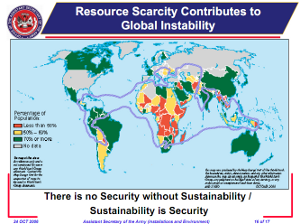
Unified Quest is the Army Chief of Staff's future study plan designed to examine issues critical to current and future force development... - as the world population grows, increased global competition for affordable finite resources, notably energy and rare earth materials, could fuel regional conflict. - water is the new oil. scarcity will confront regions at an accelerated pace in this decade.
US Army: Population vs. Resource Scarcity Study Plan
Human Farming Management: Fake Left v. Right (02:09)
ARMY STRATEGY FOR THE ENVIRONMENT: Office of Dep. Asst. of the Army Environment, Safety and Occupational Health: Richard Murphy, Asst for Sustainability, 24 October 2006
2006: US Army Strategy for Environment
CIA & Pentagon: Overpopulation & Resource Wars [01] [02]
Peak NNR: Scarcity: Humanity’s Last Chapter: A Comprehensive Analysis of Nonrenewable Natural Resource (NNR) Scarcity’s Consequences, by Chris Clugston
Peak Non-Renewable Resources = END:CIV Scarcity Future
Race 2 Save Planet :: END:CIV Resist of Die (01:42) [Full]

Fair Use Notice...

FAIR USE NOTICE: The Crime of Apartheid blog contains copyrighted material the use of which has not always been specifically authorized by the copyright owner. We are making such material available in our efforts to provide information for research and educational purposes, and advance understanding for the Boer Volkstaat 10/31/16 Theses Petition and Briefing Paper submitted to EU & NATO. We believe this constitutes a 'fair use' of any such copyrighted material as provided for in section 107 of the US Copyright Law. If you wish to use copyrighted material from this site for purposes of your own that go beyond 'fair use', you must obtain permission from the copyright owner. In accordance with Title 17 U.S.C. Section 107, the material on this site is distributed without profit to those who have expressed a prior interest in receiving the included information for research and educational purposes. Copyright owners who object to the fair use of their copyright news reports, may submit their objections to Crime of Apartheid Blog at: [jmc.pa.tf(at)gmail(dot)com]